
IT Resume Guide for 2026 Success
IT Resume Guide for IT Professionals — Practical IT resume writing tips and real-world examples. Optimize your IT resume to accelerate your job search in 2026.
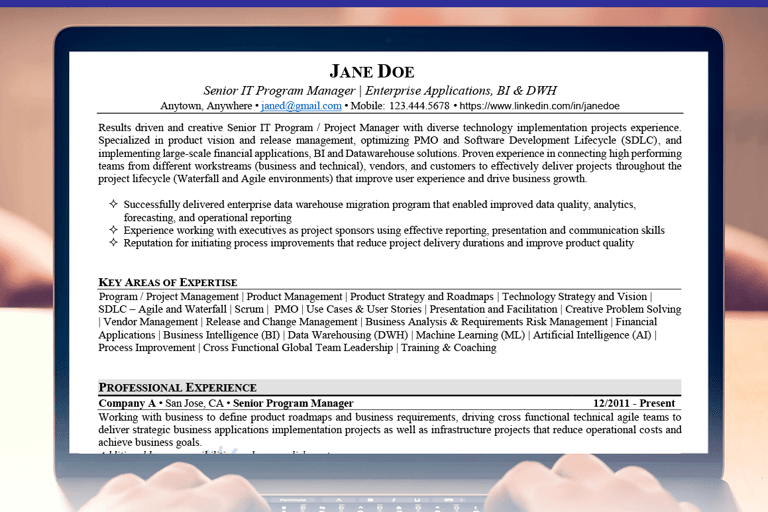
1. Update your Professional Headline – choose a headline that includes your primary target IT role and highlights your specialty areas to communicate your unique value proposition. For example:
"Network Engineer | Azure Network Infrastructure , CCNP & CCDP Certified"
“Senior Project Manager (PMP, CSM) | SaaS / Enterprise Applications”.
2. Review and update your Introduction section – it should communicate your “professional brand” and what you bring to the table. Any new competencies or soft skills that should be highlighted? Think about your differentiators and use the right keywords in your introduction. Make sure it aligns with your current career objectives and explains the unique value you can create to the hiring company or client.
Example of a Business Intelligence (BI) Analyst Resume Introduction:
“Motivating and collaborative Business Intelligence analyst with strong technical background and hands-on leadership skills. Experienced in multiple Business Intelligence (BI) platforms (Tableau, Microsoft Power BI). Strong communication and interpersonal skills; trusted by peers, management and clients. Passionate about technology and consistently collaborating with cross-functional teams throughout the development lifecycle to implement BI and data analytics solutions for strategic business initiatives.”
3. Update your Key Area of Expertise (or Key Competencies) section with your most relevant competencies, specialty areas and soft skills that are in high demand for your target IT role. Optimizing this section is critical to passing Applicant Tracking Systems (ATS) and recruiter screenings.
Technical Program Manager Key Competencies Examples:
"Professional Competencies: Risk, Issue & Dependency Management | Program Standardization | Stakeholder Management | Enterprise Application Modernization | Cloud Migration"
IT Service Technician Soft Skills Examples:
"Interpersonal / Soft Skills: Customer Service Excellence | Technical Problem Solving | Cross-Functional Collaboration | Time Management"
4. Keep track and update your resume’s Professional Experience section with recent accomplishments relevant to your target IT role. Where possible include impact and measurable results.
Product Manager Accomplishment Example:
“Successfully launched a cybersecurity solution in less than 6 months from inception to production, generating revenue of $10MM, exceeding projection by 20%”.
You can also highlight a couple of your most significant accomplishments as part of your Introduction section.
5. Condense work history that is over five years old. Consider removing listed responsibilities and accomplishments that are not adding value or not contributing to your current career objectives. You can move any position older than 12 years, or not relevant to your target IT role, to an Additional Experience section. List the position as one line that includes company name, position, and duration.
6. Ensure alignment between your Introduction and your Professional Experience. Does your professional experience section include responsibilities and accomplishments that support your introduction and your career objectives?
7. Update your Education section with relevant new certifications and training. You can highlight any new professional affiliations or awards / recognitions received from employers or clients under an Awards, Recognitions and Professional Affiliations section.
8. Update your Technical Skills section with new technologies, tools, software packages and methods with strong market demand that you have recently used and gained an in-depth knowledge of, and remember to remove outdated technologies. Group skills logically for ATS scanning and readability. For example:
Security / Networking Technologies: Cloudflare, BlueCat, Wiz, Tenable, Flexera
Programming Languages: Python, SQL, HTML / CSS, Node.js, JavaScript
9. Make sure you are using the right terminology and keywords recruiters and ATS systems are looking for. Update keywords in your resume’s Introduction, Key Areas of Expertise (or Key Competencies), Professional Experience and Technical Skills sections. In order to get a sense of market demand, you can simply search on job boards for positions associated with specific technology, skill or methodology. Here are few examples for project management related keywords searched on a job board and the number of jobs associated with these keywords nationwide:
“Budget Management” – 11,750 ; “Scrum” – 43,460 ; “JIRA” – 34,400; "Software Development Lifecycle" - 12,000. You can search for any other keyword relevant to your target position and location to get an idea of industry demand.
We hope these tips provide useful guidance for optimizing your IT resume.
Address
980 Rowland Street Clarkston, GA 30021